Nostalgia, I have always felt, must be a luxury: a sweet treat for those contented with their current lot, but a terrible vice to the discontented.
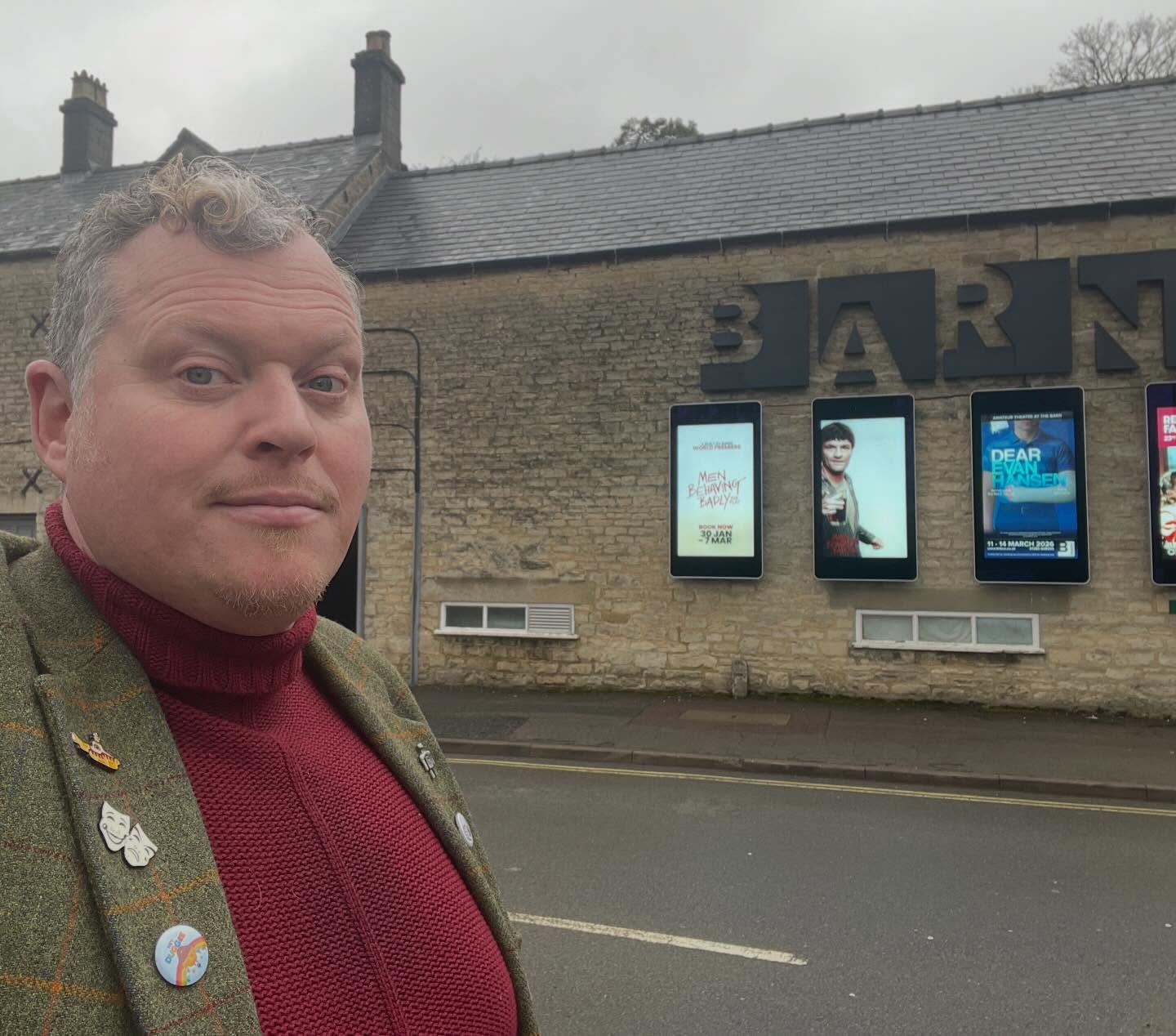
Since embarking on my Histories of Britain ‘journey’ – and yes, the Anglo Saxon Chronicle is taking an age to appear on Audible, I’m almost ready to send off Vol IV: ‘The Worcester Chronicle of Chronicles’! – I’m well used to travelling to small towns bursting with history stretching back to the Darker-Than-Some-Later-Period-Ages, not least to grab some photos, as KDP Publishing does prefer some illustrations if you’re releasing public domain material (of course, this book series is all about the incredible, witty introductions…). All that said, it wasn’t history that ancient which brought me for the first time to ‘the capital of the Cotswolds’ – Cirencester (although I did make sure to take a few snaps of where the Abbey used to be, as the town does crop up a fair bit in the chronicles). This was a personal, surprisingly emotional journey back thirty years, to my own all-but-forgotten adolescence: to see the new ‘Men Behaving Badly’ play. And I found the bizarre experience so emotionally charging, and it left me with so much to stew over, that I couldn’t resist an impromptu blog.
First of all, it wasn’t an unofficial sitcom dining experience. That in itself was a huge blessing for so many reasons. And Simon Nye is a greatly underrated writer – okay, so his take on HE Bates’ Larkins wasn’t the direction I’d have gone for, but his pantos are lasting comedic jewels, ‘How Do You Want Me’ was a heartbreaking lost classic, and ‘Is It Legal?’ should have been as big a beloved comedy hit as this behemoth sitcom we’re now quizzically celebrating. Despite many imponderables, I decided it would be worth the pilgrimage just to see what Nye could do with a theatrical space.
Thanks to Dr Beeching, I would have found it next to impossible to get there and back without my wonderful wife to drive me (and keep Fred amused while I attended the matinee), and it always feels weird being in a town that big, which has no train station or sensible transport links. I thought Glastonbury was bad enough! I say this not to disparage Cirencester, but just to underline the sheer eccentricity of this being the place where, after thirty years of dormancy, ‘Men Behaving Badly’ has staged the world premiere of its return. It’s actually not the first time the Barn Theatre – a very small and friendly little venue out on a suburban side street – has played host to the revival of a classic comedy series. Two years ago, ‘Some Mothers Do ‘Ave ‘Em’ was rebooted there with Joe Pasquale in the beret, and last year it was the turn of ‘Yes, Prime Minister’ to unveil its final chapter, ‘I’m Sorry, Prime Minister’ – which I’ll be seeing in Bath on my birthday later this year.
Nonetheless, this quiet little reboot was absolutely not the next expected step from Simon Nye’s colossal ’90s hit. If the show had ever flitted into my mind in recent decades, it was with the inevitable thought that maybe we were due an ‘Old Men Behaving Badly’ series, with the cast returning for a timely take on gender politics in this new era. The reasons for that not happening are probably legion, but I still can’t pretend that an all-new play set just a year or so after the last ever final episode of ‘MBB’ went out is a scheme anyone was expecting. It was actually news to me that the sitcom had only lasted from 1992 to 1998, such a brief reign – in my memory that final trilogy was well into the new millennium, but nope, those characters did come to a seemingly final end that long ago. But then, as I say, in all these years as a comedy historian, ‘Men Behaving Badly’ has barely spent a full minute on my mind.
The experience of trying to get across to my (extremely Britophile comedy-loving) wife just how GIGANTICALLY HUGE ‘Men Behaving Badly’ was in the UK, while she was still a child in the Netherlands, was certainly quite irking. Because how could it have been that MASSIVE, and yet be so entirely evaporated from our culture in the intervening thirty years? Its yank ‘pals on a sofa’ contemporary ‘Friends’ has never quite gone away, it hasn’t stopped being repeated somewhere or other – although that is another sitcom which at the time I would never have dreamt of missing, but which I have never, ever revisited even once since the last episode went out.
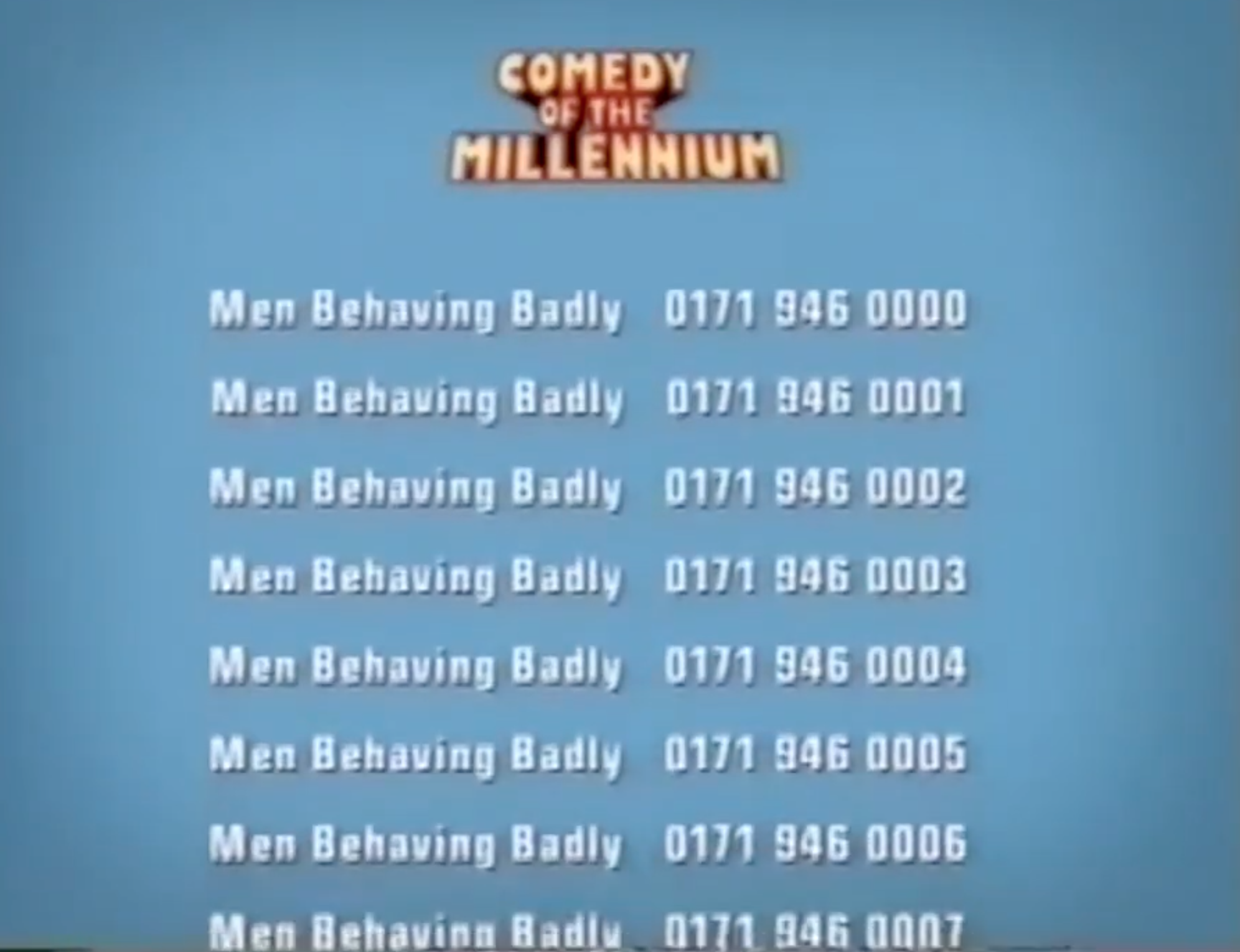
The 1999 30th anniversary Monty Python night even had a whole joke about the ubiquity of ‘MBB’, damning the BBC for never celebrating anything “made before John Birt was the DG” by listing nothing but ‘MBB’ for ‘Comedy of the Millennium’. How ironic that now seems, given the show’s near-total erasure from our culture. But yes, at the time, ‘MBB’ merch was everywhere – there were the tie-in books, the board game, the shower gel and lager-mitts (or did I dream that?), so many ludicrous products all nicely padding out the Nye bank account.
Somehow I felt it was my duty to go back to that skanky little London suburban two-up, two-down, even if the odds of ever using the experience in my work seemed slim, simply because of that wide-spread cultural amnesia, here in this 21st century world in which Clunes is a dog-bothering ITV star and Morrissey a familiar jobbing straight actor and sometime publican. I remember my publisher suggesting, early in the 2010s, that I put my hat in the ring to write the official ‘Father Ted’ book, but I turned the offer down, saying that fifteen-odd years wasn’t enough for it to have matured into ‘classic comedy’, and I’d revisit the idea a few years on – talk about dodging a lethally toxic bullet! Feck it all. But although it would of course be a great honour to be author of something like ‘Old New Lads: The Men Behaving Badly Phenomenon’, and to make good use of my journey to Cirencester, I challenge you to locate one publisher who would green-light an official history of a show which ruled the sitcom roost so all-encompassingly throughout such a halcyon cultural period… only for the whole multimedia comedy juggernaut to end up as a kind of mass black-out from a fantastically hedonistic night out, rarely mentioned and never repeated, and surely unlikely to be considered SEO-friendly and bankable in this day and age. But thirty years ago, you could have bought a sizeable country cottage on the royalties from ‘The Men Behaving Badly’ story.
So I might not be pitching that book any time soon, but then, you may be frotting to ask, if that’s your attitude – “Bloody sod you then!” – was I really that much of a fan anyway, back in those backward days? I’ve found it worryingly easy to completely forget that I very much was.
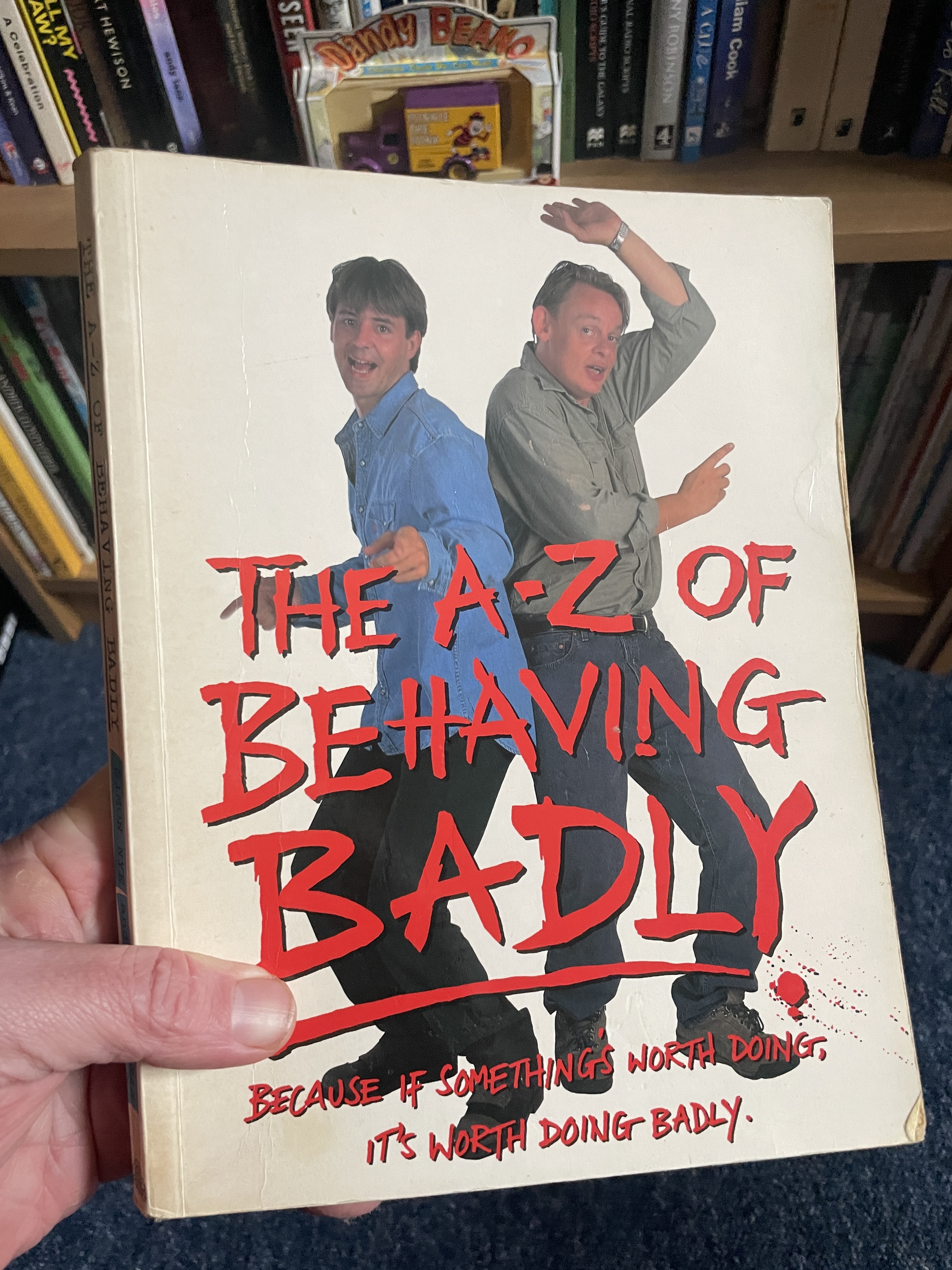
We can spout at length, of course, about the sheer brilliance of Clunes, Morrissey, Quentin and Ash, about Nye’s skill at crafting the silliest of jokes (and infamous lack of skill when it came to keeping track of any kind of canonical character history, like whether Gary passed his driving test, or what Dorothy’s surname was), and indeed about the zeitgeist of the New Lad phenomenon. My deep lost love for the laddish universe of Gary Strang and co really has its roots in Simon Nye’s original novel – that small scuzzy potboiler which caught the eye of comedy Titan Beryl Vertue, who pushed it sharply on its long torturous journey towards TV greatness. The scene where Dermot helps the frail old lady who can’t open a jar because of arthritis has never left me, it’s a strangely moving book. But that small-scale literary exploration of the way in which young men do behave badly was a completely different animal to the dribbling beast which eventually ruled over the late ’90s comedy scene – could I really have been a fan of all that obnoxious lager-lager-lager-fuelled tomfoolery? Those dick-heady days of Stella Artois and Marlboro Red (and no tuition fees) comprised my entire teenage development, and by the last three years of the decade, I was a student – that most hated target of Gary and Tony’s derision. So much time has gone by since, so much education and re-education, I hadn’t given that side of my teenage psyche the slightest thought in whole epochs of time. But yes, I laughed at the shows, I taped them off the telly and perfected the exact jagged lettering of the titles so perfectly on the video boxes, my capital handwriting is still shaped by them to this day. I had every single episode on VHS, both shop-bought and self-taped, and must have seen every episode several times each.
But I had all-but forgotten it all. This play is set on Millennium Eve. Where was I for that oh-so-once-in-a-hundred-lifetimes evening? I remember a party in Aberystwyth, rolling Js in an attic somewhere up the posh side of town. There would presumably have been cheap champagne. But nope, bar a couple of vague cerebellum-sparking flashes, I remember nothing of my Millennium Eve at all. That was a different boy. Me and my fellow young men behaving badly really did live it up, smoking, drinking, dancing… almost everything except having sex, frankly (Okay, that may have just been me). Having not given it a single thought in thirty years, I even remember I once put together an epic version of Roy Chubby Brown’s ‘I’m A Wanker’ song, as featured in the show, because there was another comic ditty doing the rounds called something like ‘I’ve Cummed Up’, and it bothered me that it was so similar to the Wanker song, so I created a mash-up:
I’m a wanker, I’m a wanker,
And it does me good like it bloody well should…
So not only were we lucky enough to be the last generation to flaunt our unreconstructed machismo around, while smoking indoors, we had the overriding STUPENDOUS good fortune to be doing it before we had smartphones and social media, which would otherwise have allowed us to capture this utter fucking dreck and slap it up on YouTube forever, to our eternal shame. Our teenage/student boorish nonsense remains rotting away on videotape, unwatched and best forgotten. Luck upon luck.
Not that Nye and co weren’t always also having their cake and eating it, by the way – “Except on Friday, when I have a small cake…” – whatever their effect on impressionable young yobs like me, it would be wrong to portray ‘MBB’ as wholly loutish, almost as wrong and point-missing as using Alf Garnett as an avatar for right-wing bullshit, when the character existed solely to satirise such views. Because Gary and Tony were of course complete losers, their philosophies were drunken bollocks, and that was the whole point. But we were all scoffing cake and having it in the ’90s – some of us without remotely realising it. Like the heroes of the show, in our vague, unthinking ways we fancied ourselves as feminists by default. There’s certainly no denying to earnest young men of today that our generation of ‘New Lads’ was insanely spoiled by our freedom. New Laddism got to ruthlessly objectify women while claiming that feminism had ‘won’, and that everything was fine now – when it came to ’90s gender politics, comedy was suffering under the same so-called ‘post-ironic’ delusion that would extend in the following decade to encompass race, sexuality, and a whole host of other spectra, giving us ‘Little Britain’ and ‘The Office’, and the same shitty excuses used to this day by the likes of Gervais and Carr, that white straight men can say whatever they like, because ‘all the battles have been won’.
I suppose these concerns of the modern Jem would make me one of the ‘wokey’ Gestapo who come in for a very brief speck of derision in the new play, Nye still having his cake and chowing down on it – “Have you got any cake?” – even in the far less ignorant climate of the 2020s. Thankfully, it would be a lie to say that being ‘anti-woke’ is at all a theme of the show, and the one extremely fantastical moment which touches on the issue is both mercifully brief, and equally reflects the stance on gender politics which one would expect to hear from a comedy writer who likes to please his audience, and has a number of grown-up children around to patiently explain what is acceptable today. But the suddenly unavoidable contrast of my modern self, far from flawless, but certainly painstakingly educated over the years by a number of inclusive feminist partners, with the Stella-chugging lad of 1998, may have played a part in the highly unusual emotions the new play bubbled up inside me.
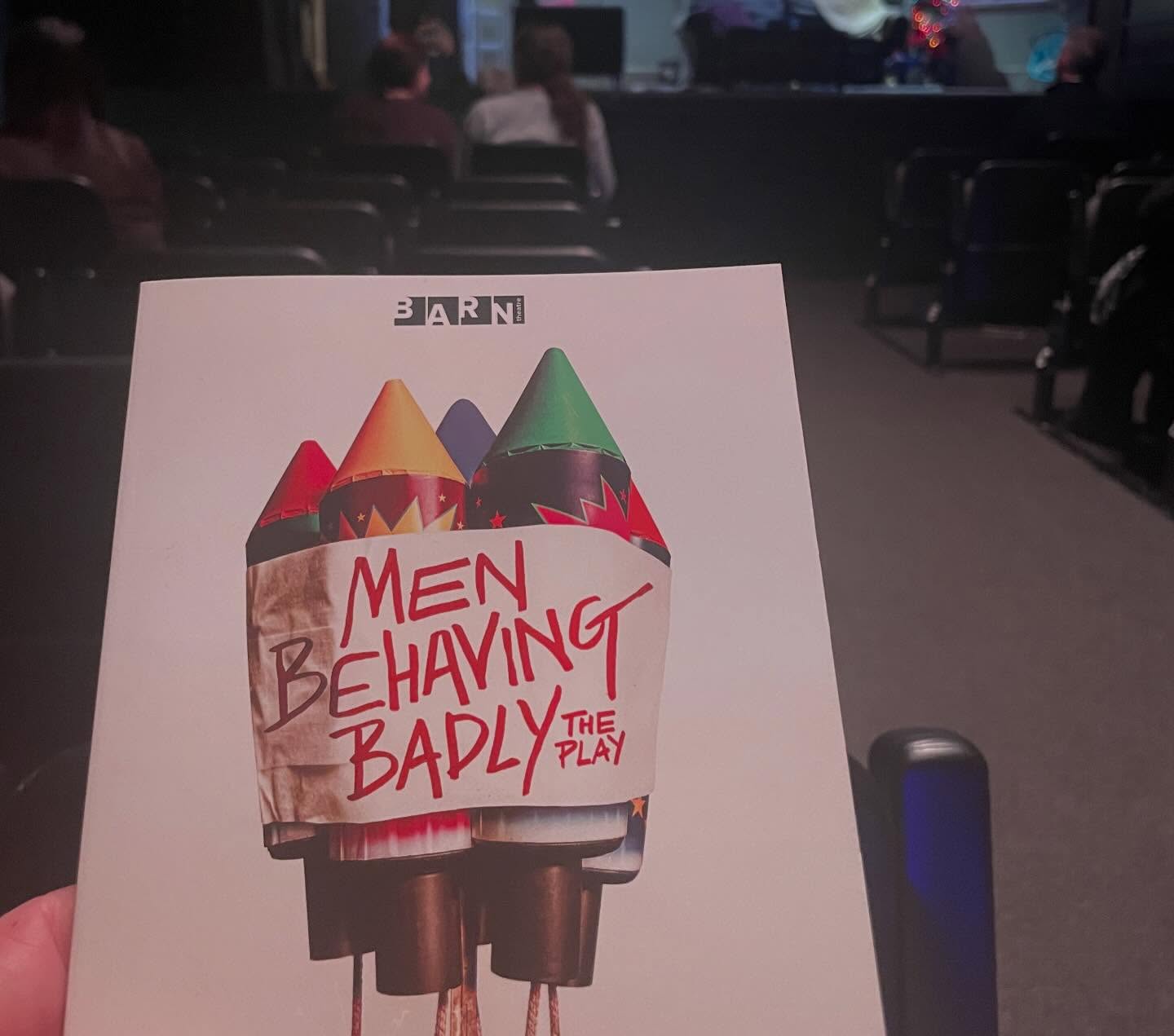
I’ve said far too little about the production itself, and I’m hugely glad not to have to professionally review it for any kind of proper periodical: the goodwill generated by the whole project would make full honesty painful. The cast are to be utterly garlanded for their incredible resurrections of the familiar characters, certainly vocally – Neil Morrissey’s guileless burr may seem like a familiar impression, perhaps thanks to Peter Serafinowicz, but who even knew Caroline Quentin’s stentorian tones could be impersonated at all, let alone imagine the wonderfully tributary depiction of Dorothy given here by Ellie Nunn? The only actor not given an almost creepy new lease of life in the production would have to be Martin Clunes, whose rubbery delivery proves to be hard to pin down, but Ross Carswell certainly had a hell of a task in hand, taking on the mantle of Gary Strang, the central support for the entire enterprise, and his performance had enough of the ‘slightly posher, sadder pink-faced rugger-bugger tosser’ feel to him to successfully give us back a couple of hours of Strang at his near-worst. The mechanics of the play (which fittingly only switches location between the all-too-familiar front room and, of course, the pub) dictated that a large part of the success of the evening was down to Neil Jennings, who may have borne little resemblance to a young John Thomson, but brilliantly portrayed his clueless pub landlord Ken, like a kind of irritating karaoke-obsessed 18-30 holiday rep, geeing up the grey-haired 30-70 audience with aplomb.
But then, I was under the impression that once I had seen the play, I would fully understand why Simon Nye wanted to add this three-decade-late coda to what I thought was a perfectly satisfactory done deal of a conclusion back in 1998. Back then, Gary and Dorothy were new parents, Tony had become a boring postman, and finally worn down Deborah, and all was happily tied up. Surely this play wouldn’t undo all that without good reason? Well, yes, it sort of would. This really is just plotted largely like a typical episode. There are even laughs at the expense of the desperation to impose theatrical peril on the situations, when frankly it is just an excuse for a nostalgic wallow. I will stress that SPOILERS NOW FOLLOW FOR THOSE WHO ALREADY HAVE THEIR TICKETS, but the biggest problem of all was the way in which ultimately the show brought everything back to the relatively happy enough status quo Nye had crafted for the characters 30 years ago anyway. From the original novel onwards, all through the show’s 42 episodes, ‘MBB’ was ultimately all about Deborah, and whether she would settle for a twat like Tony (or Dermot, originally). Gary may have been the lynchpin of the series, but that ‘will they won’t they’ toss was the fundamental thread of the whole show, culminating in her finally being worn down by the last episode. To suggest any degree of drama for the play, that happy ending has been initially destroyed, with Deborah discovering her metier as manager of a kangaroo sanctuary in Australia, only briefly back in Blighty for Gary and Dorothy’s (finally legal) marriage. A fair bit happens in the intervening couple of hours, most of it drunken and totally inconsequential (and totally unbelievable if you’ve ever had to constantly worry about childcare for tiny tots), but somehow I seem to have missed the most important bit of the whole play – why the frig does Deborah change her mind, and come back to Tony for good? Where her tragic wearing down in the TV show kind of made sense, and it was the ending we all wanted, in this play she simply switches in an instant from dead-set on her new life in Australia, to wearily committed to the borderline-mentally-ill chronic loser Tony Smart, surmisably due to a ticking fertility timepiece. And I’m sorry, but in a way, this lack of motivation for Deborah has to be the single most misogynistic note in the entirety of ‘MBB’ history. She might want a baby, so she forgets about her dreams, and settles, without any convincing moment of revelation, or decent excuse. There were a number of ‘missing stair’ feelings in the play’s plot, but that was by far the worst – correct me if I missed an essential line which explained it all! Oh, and while we’re in this spoiler zone, the Neil Morrissey guest star element was very well embedded in the plot, and probably provided about 90% of any excuse for the play’s existence, giving Nye the only way to contrast today’s attitudes with those of half of most of the audience’s lifetimes ago. But it was still not easy to fight the tangible feeling of “what the fucking flip am I actually watching here, and why?” I’ve probably seen ‘The Producers’ too often, because it began to feel like some sort of tax dodge. SPOILERS OVER.
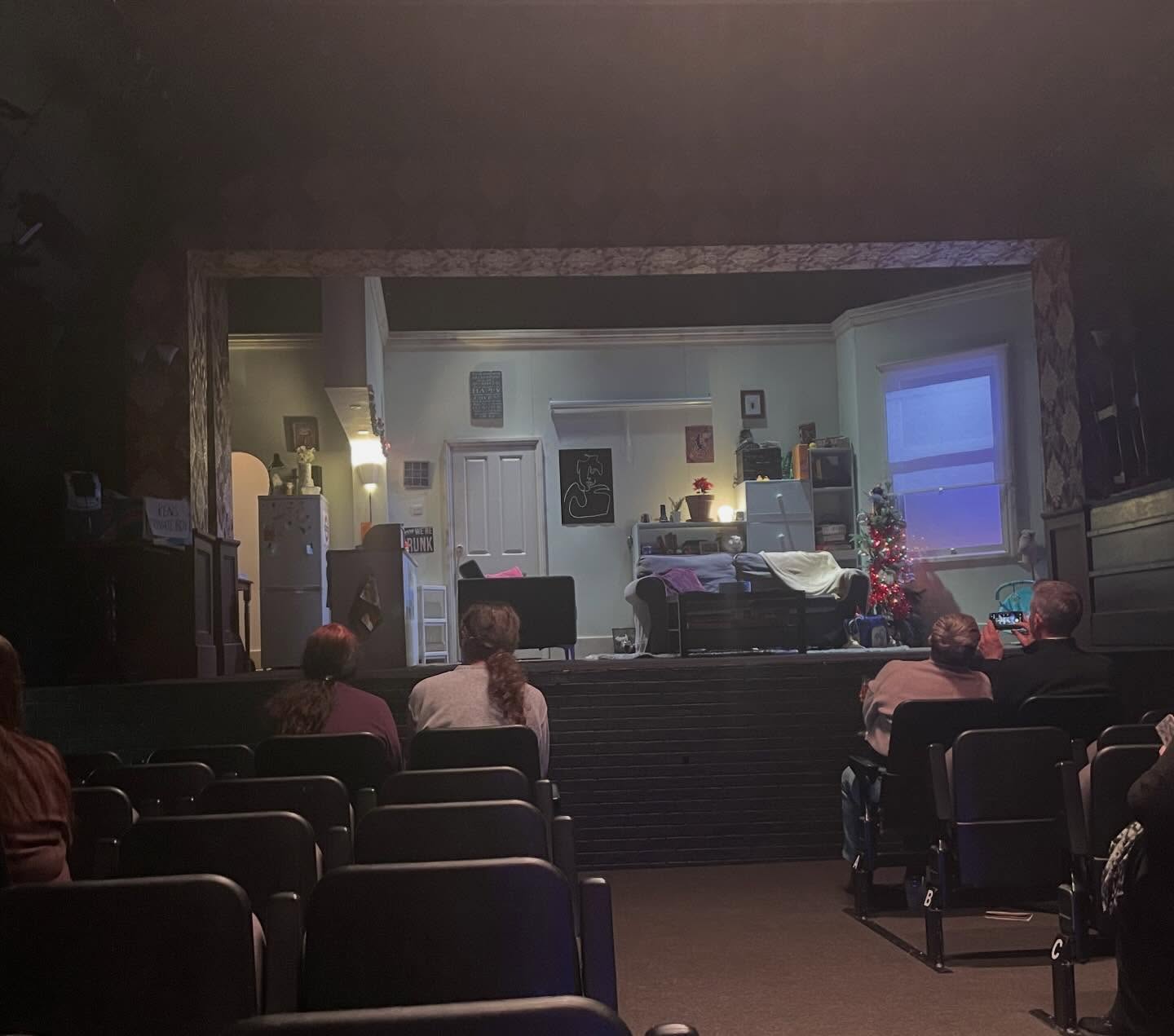
But then. Ah, but then… it was such an unexpected feeling, to have those totally forgotten parts of my memory banks, both personal and cultural, suddenly lit up in this somehow exposing way, and I cannot deny the play is A) very funny, as ever, and B) genuinely moving. The trigger came at the very end, when Gary’s well-set-up-in-play projector began to show sundry home movies from the mad late youth of these four beloved sitcom characters, with a beautifully reconstructed version of the daft home video footage which opened most of the latter episodes of the TV series, scenes which I saw so often but hadn’t given a thought to since I was a fresh graduate… and to my total astonishment, I felt tears pricking the back of my eye sockets. Tears for what? Nobody could deny it had been a very silly afternoon of pretty gullibility-stretching sitcom silliness, but in that moment, as the cast took their bows and had their dances, I had to fight to retain composure. Being a man, of course, I sucked it up, swallowed down those tears, and asked myself what the BALLS I thought I was playing at, threatening to cry at a ‘Men Behaving Badly’ reboot. Who was I crying for? The unreconstructed chain-smoking lager-swilling teenage me? The stressed middle-aged not-even-allowed-a-nice-ale me? Deborah? The kangaroos? Simon Nye’s accountant? Maybe the small bottle of Pils I had necked in the interval to mark the occasion was to blame.
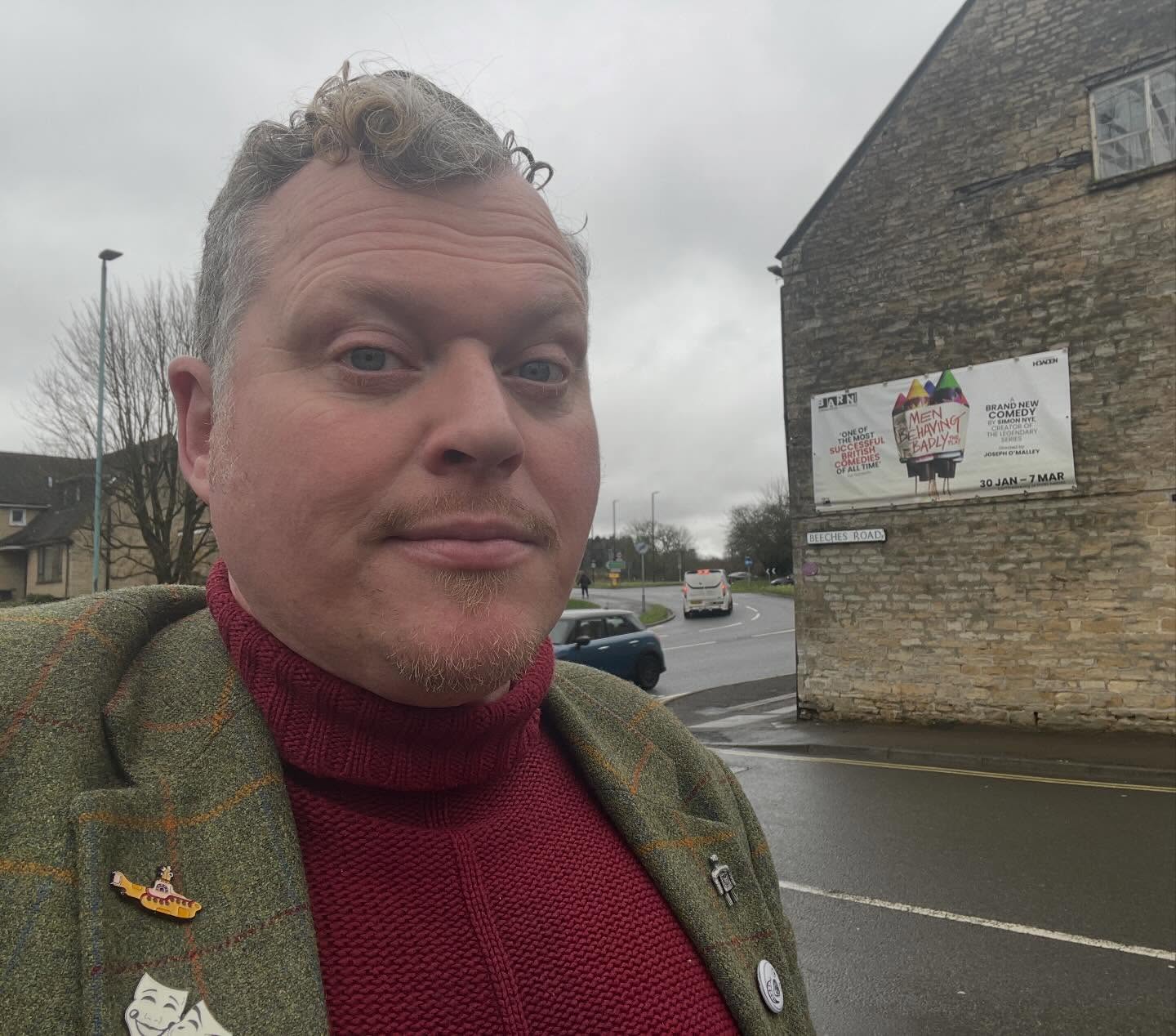
I just don’t know – and now I’ve written this blog, I still don’t have a clue. But I’m very glad I went to see the play, despite the bizarrely low-key location. It doesn’t feel enormously likely that a glitzy West End theatre will be clearing its diary for the production any time soon, so I now realise I simply couldn’t have forgiven myself had I not taken this one chance to step into that boozy time machine at the Barn Theatre, and taken that trip.
But let’s just hope it does well enough to heighten the likelihood that Simon Nye can get the old gang together and finally give us a geriatric update on the New Lads saga, which will regain some of that success of thirty years ago – and, that done, I can reconsider pitching for the job of crafting the official history. What could we call it? ‘Beds Are For Sleepy People’? ‘Big Ears and Knobby’? ‘Beryl’s Boys’? ‘Live Forever’? ‘Tiny cogs’? ‘Croydon Is Tremendous’? ‘The Anthea & George Story’? ‘And So Leave’? ‘The Girl Upstairs’? ‘Protection, and a Scone’?
Damn. I think I need to start an epic rewatch now – and it hasn’t even been released on Blu-Ray! This may get painful…
 Jem Roberts