Well, what a merry Christmas this now shall be for you all! At the ten-and-a-halfth-hour, Audible has finally announced the arrival of the FIRST EVER audiobook recording of the entirety of Geoffrey of Monmouth’s History of the Kings of Britain – a totally insane epic tissue of fantasies written by a Norman monk 900 years ago to make the ridiculous claim that the Normans were actually the TRUE Britons, descended from the brave natives who fled to Brittany, rather than the degenerate Welsh Britons who stayed at home and his up in the hills.
I first read Geoff’s history many many years ago – a lot of his legends inspired retellings in Tales of Britain – but I hadn’t realised that this was the intention of Geoffrey’s propaganda until I came to edit and perform the book for Kindle and Audible. This Histories of Britain project is proving genuinely educational, and in these times of unprecedented fake news and official propaganda, it couldn’t be more timely to take a long look at the history of lying in this way.
This is also the first HOB instalment to have photographs in the print and Kindle editions – this was initially to make it easier to self-publish, given Kindle’s weird system, but having travelled the country for years with TOB, I have plenty of interesting photos from all over, to illustrate the text, so this will now be a permanent part of the series. I’m currently editing the third Histories of Britain audiobook, which is already online in eBook form, and should be available in all formats by mid-January. Then there are three more instalments to follow before I decide how to tackle Holinshed’s History of Britain, which is almost as big as all the others combined…
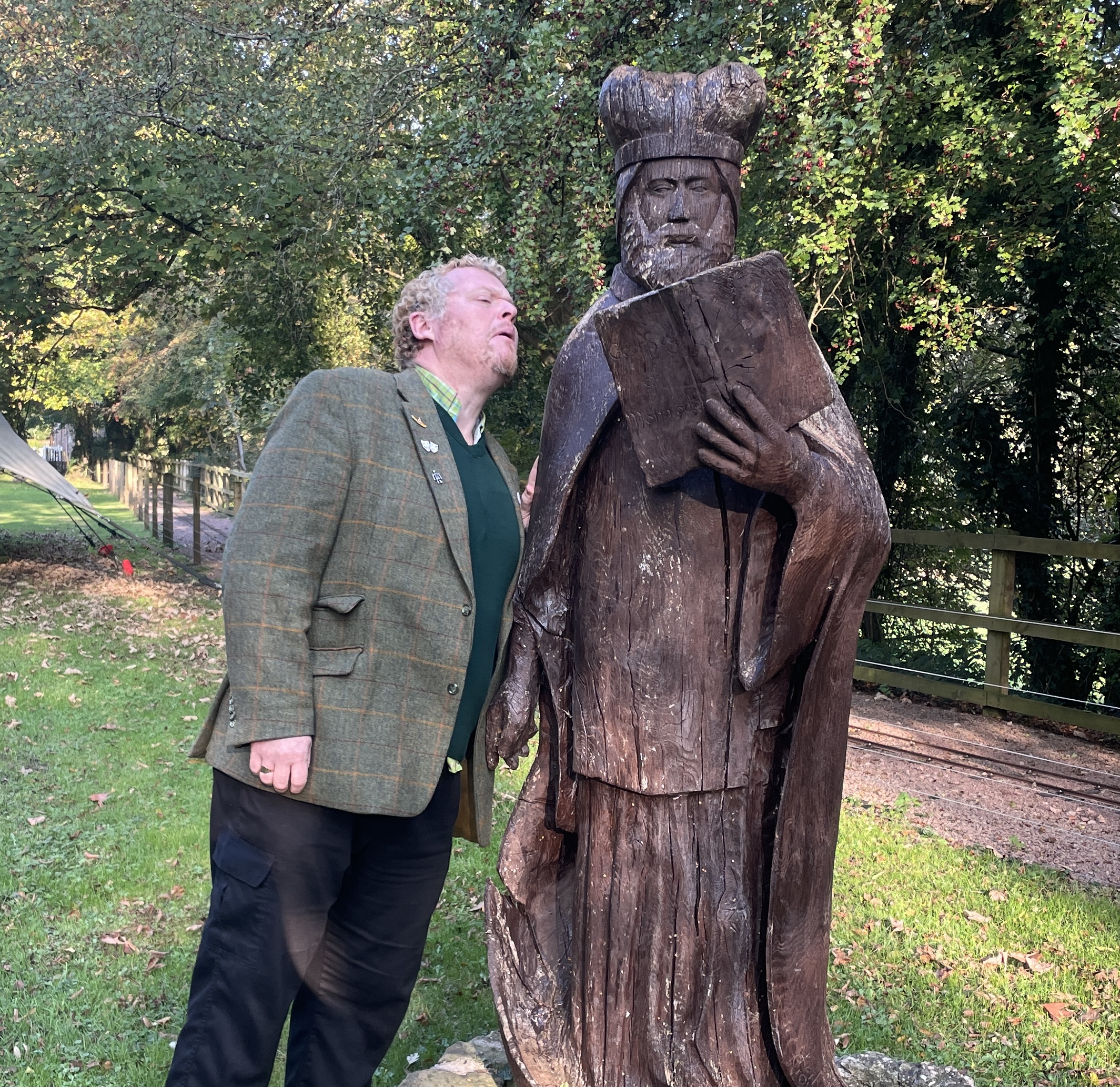
Editor and author compare notes, near Tintern Abbey.
The whole point of the Histories of Britain project from Day One was, of course, to perform these ancient texts and make recordings available for – as far as I can tell – the first time ever, certainly on Audible. And I sincerely hope people are finding the audiobooks enjoyable and fascinating, because it’s a real honour to perform them. But also, of course, amateur historian though I may be, I’m also writing fresh introductions to the books, sharing my findings as I rediscover and perform each work of history/insane fantasy. So although I hope you all dash off to Audible now to download the full audiobook, here’s just a taster of my new introduction, to whet your appetite…
‘Historia Regum Britanniae: A Norman Fantasy
by Galfridus Monemutensis Arturus’
Or, a better title: ‘Story Time with Geoffrey’
By JF Roberts (2025 CE)
At the old station – a pretty ramble away from Tintern Abbey, near the most southerly gateway between England and Wales, you will find an oaken statue which stands in a circle of six skilfully carved local celebrities. One, Sabrina Hafren, the Romano-British spirit of the river Severn, seems quite inarguably mythical. Another, Arthur, must be the single most infinitely arguable mythical-cum-historical figure in our whole planet’s folklore. Joining them in the ring, along with sainted British King Tewdric, King Offa from the enemy Saxon camp, and the massively tangential Queen Eleanor of Provence, wife of Edward Longshanks, stands the most local hero of them all.
This beardy-weirdy wooden wise man was no King, and indeed no Saint, but we know of him as the first great Welsh historian – Geoffrey to his friends – and this Geoffrey of Monmouth was one of the absolutely key creative minds behind the promotion of King Arthur as a kind of Patron Saint of Britain, and the greatest monarch in the vast firmament of rulers throughout Britain’s long semi-mythological patchwork saga. He was born into a freshly Norman society, at the turn of the 12th century, and devoted his life to academe in Oxford, where, some time in his late thirties, just as the death of Henry I was about to plunge Britain into nearly twenty years of Anarchy which would last for the rest of his life, our Geoffrey saw his magnum opus, Historia Regum Britanniae, or The History of the Kings of Britain, published.
His earliest narrative kicks off with the Trojan war, roughly estimated to have taken place around 1200 BCE, and he eventually taps out at Book 12, around the turn of the 8th century CE, asking the reader to look elsewhere for details on the more recent Welsh and English Kings, as not being his area of expertise. In between these two points in time, a great deal of elaborate and complex British history is documented, which has been turning historians’ hair white for nine centuries.
Strictly – if not mercilessly – speaking, there is only a tradition that this ‘Geoffrey of Monmouth’, giving him his English monicker, is actually a native of Monmouth at all, as many modern historians would happily point out – probably with hands on their hips and an egregious smirk across their faces. These strict adherents to the facts would be sure to stress that this ‘Geoffrey of Monmouth’, in inverted commas, was actually more likely to be a second-generation immigrant from Normandy or Brittany than a Welsh-speaking scholar of hot British blood.
So the Welsh historian may not have been Welsh – but was he even a historian? Again, a very few modern-day historians would be happy to use such a hallowed term to describe this 12th century man of letters. To officially define the narratives he published in the name of ‘history’ as a reliable academic source would bring those aforementioned modern historians out in hives. So what was he, this Geoffrey? A storyteller?
You’ll have to buy the book ins some form to find out, won’t you? And BEWARE FAKE NEWS!

